Translate

Thursday, March 6, 2014

Get Your Hands...and Feet...Dirty. Build Your Own Horno!

El Camino Real Historic Trail Site--Truth or Consequences, New Mexico

This blog is one of those that I mentioned about taking liberties with "Chuck Wagon Musings", in that it has to do with cooking and the period of time that we were using the chuck wagons....just not wagons per sae. You will notice the Dutch oven in the opening, so...... there you have it, the connection to the chuck wagon.

What the heck is an horno you ask?  It is an outdoor oven built from Mother Nature’s materials....clay!  It is also a cool looking structure you can find all over the southwestern part of the United States.  They can be spotted around Native American establishments or communities.  It is basically an oven and can be used to cook a variety of things ranging from bread to meat, and of course a more modern dish like pizza.  Just about anything can be cooked in an horno that you ordinarily cook in a conventional oven. The fact that you use your hands--and feet to mold the clay into shape for construction of the oven is also rewarding.  I might add a warning here that you should be prepared to spend some time digging the mud out from underneath your fingers and toes because there will certainly be a lot lodged under them.  Or maybe it would just be easier to get a manicure and pedicure.
Saydbea photo from Flickr

I think it is particularly rewarding to be able to construct anything that serves a useful purpose, and I find this adobe structure especially fun when company comes over. Several years ago my wife Linda and I decided we wanted an horno (earthen oven) in our back yard, so I started looking for written material on the subject.  We found that Adobe Architecture by Myrtle & Wilfred Stedman was mostly about adobe home construction; however the last few pages were dedicated to The Indian Oven.  That part was a running dialogue by Eva and John (pueblo Indians) with diagrams by Myrtle Stedman on how to construct an oven.    The original article (1969) was the first of its kind, and this Adobe Architecture printing was in 1978.

Having read this article and anything else I could find that gave me information about adobe, I decided to embark on my first horno.  I called my friend Skip Clark who had done extensive work in refurbishing the Socorro Mission in Socorro, Texas located just a few miles from our home as well as the old jail in San Elizario, Texas.   I enlisted his help, promising him Indian bread and a cold Tecate beer with fresh limes as his pay.  He readily accepted and we started on the project.  After locating the business of Señor De La O, an “adobero” in Anthony, New Mexico,  we took my old trailer, made a couple of trips back and forth on the interstate, and brought back enough adobe bricks for the oven.  I made a couple of trips because I was also making a banco (bench) and a kiva fireplace in another part of the yard.  

A lot has been written about the proper orientation of the horno to make best use of the prevailing winds and such.  For me, the location was simple because I had just one place that it could be located, so I didn’t think too long about details, like the direction of prevailing wind.  Some printed material more recently published such as Build Your Own Earth Oven, by Kiko Denze offer specifics such as which direction to face the door of the oven and the types and composition of the adobe.   He also discusses other excellent information as to how one can utilize a sand mold and how to use cobb (wet mud) instead of adobe brick.  I located an area in the back yard and decided to face the opening of the oven towards the southeast, not because of any profound reason, or suggestions by noted authors, but because it faced the grape arbor and the bunkhouse and that location seemed to be the best visual location to build.  And besides, I’m probably not going to be cooking in adverse weather to begin with.

I had a design in mind with a ledge all the way around the oven that could be utilized as a seating area in case anyone wanted to visit and watch as bread was being baked in the oven.  (Pretty exciting stuff don’t you think?) This seating area was to be about five feet across, and the oven was to be ABOUT four feet in diameter.  With those two features in mind, Skip and I began laying the adobe in a circular pattern up to a height of about 16 inches.  Then we back filled with dirt and rock and firmly compacted the center portion and wet it down so it would be good and stable and hopefully not settle too much.  After letting it dry we added a flat course of adobe that would become the floor of the horno.  When the floor was completed, we filled in all the cracks to make a very smooth surface, letting it dry completely before adding another thin layer. 


At this point we were undecided as to whether we should lay the adobe flat to make the walls the width of the adobe or to lay the adobe on the edge and make the horno the thickness of the bricks.  We decided to lay them on the edge because it would take fewer bricks using this method.  The trick in using this method was the adobe had to be leaning to the inside and their position had to set with wet mud. To achieve this we leaned one brick against one placed perpendicular to it to keep it from falling over.  We continued in this vein until the bottom course was done from one side of the door opening around to the other side of the same opening.  The next step was to fill in all of the voids at the ends of the bricks and to mud the bottom inside edge to give it a extra strength.   Then we waited until this course was dry enough to support the weight of the next course and followed the same method of laying a course of wet mud, then setting the bricks in a leaning fashion which is already at a pretty steep angle because the dome has to be formed with a third course of adobe.  The last part was the actual key that becomes the uppermost part of the dome or ceiling.  It is sort of tricky here and all the voids must be filled to give it the necessary strength.  If you lean on it the wrong way the dome will collapse.  

It is important that you make a smoke hole.  This can be done in many ways. You just have to keep in mind that it will need to be open when you are burning your wood and closed once you put bread into the oven and seal the door.  I had an old ball and chain that we once used in a Celtic festival.  I just made a hole and filled in around the ball up to the half-way point, and it was easy to set into the hole and seal off the heat.  Once everything was good and dry I added a coat of cement plaster over the outside of the oven.  This sealed up and protected the mud from water invasion.

Well, the best laid plans of mice and men don’t always go the way you want them to.  I guess somewhere along the line I failed to read that using cement was not advised.  You see, when the cement expands and contracts it tends to crack the surface.  The water invasion occurred very slowly, sort of like a sneak attack.  At first just a few cracks appeared, and then some pieces began falling off.  You get the picture.  It was still strong enough to support my son’s 6’3” friend on top of the horno.  He told me later that the top of the horno was his favorite location when they would have their “dart wars” in the back yard.  It was a few years, maybe three or four before the collapse of the horno.  It was during the summer of 2006 when we had monsoonal rains, and the water invasion was complete, and the horno was for what the bell tolled.  We went out one morning with our coffee cups in hand heading for the bunkhouse, and we saw the horno was nothing but a heap of clay. Only the bottom course of bricks was still leaning and still standing.  As is said at funerals-ashes to ashes, dust to dust, and now horno back to dust.  This horno was now history

It was before I had a camera phone when we built the first horno and I can't find any documenting pictures of it.  The base that is pictured above is all that remained of the old oven.  I did save the clay and reused it addiing straw for strength.  All of the pictures after this point are from the "new build".  What was fascinating was the mechanical wonder that Mr. De La O engineered to make his adobe making business move into the 20th century.  It truly is a wonder when you stop and think...the adobe has been made totally by hand since Biblical times so his invention is a giant step forward.  There is a separate hopper for mixing the clay 


and various stablizing agents such as portland cement, straw, animal manure, etc.  Then he backs up to the hopper and a conveyor delivers the adobe to his adobe making machine.  He or one of his sons can then drive to the drying area where the machine exudes the adobe into the molds and then deposits the adobe block out onto the ground for drying.  Quite unique....V-8 engine and other various smaller engines to deliver power to the various mechanical systems.  So the adobe is real old school with a new twist.  I like to think that my abobe oven is the horno that O built! 
 This is a multiple post for the adobe oven, so stay tuned for the next installment...

Sunday, February 16, 2014

Sourdough Sunday

Just a couple of days after Valentine's day and really enjoying this 83 degree weather in El Paso, Texas.  I have started on a rather lengthy project for a blog and realized that I needed to write something in the mean time.

This blog is about a sourdough biscuit recipe.  The recipe I have included is one I duplicated from my long time friend Glenn Benson from Del Rio, Texas.  For those who do not know, he was my 8th grade Industrial Arts (shop) Teacher .  It was one time in Del Rio that I had gone to help him out a little after some surgery when I noticed a recipe in his kitchen window. I thought it was pretty cool since one of the recipes was mine and one belonged to our friend Billy Foster.  I noticed that it was written on the back of a shooting target.  I looked around and found the same targets and replicated the recipes just as Glenn had written them.   Well anyway, one morning I asked Glenn if he wanted some biscuits and of course he responed with a "why hell yes". I think I made them a couple of times and they were sure fine.

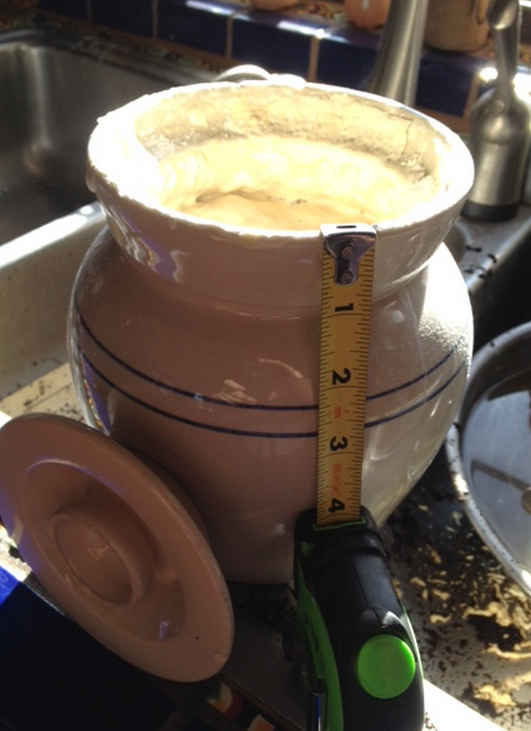
I have had several sourdough starters in the refrigerator over the years, some lasting a couple of years or so. The last starter died a couple of weeks ago for some unknown reason.  So I had to make some more.  Now those of you who know all about this sort of stuff--don't get your danderuf up--just bear with me cause there are a bunch of folks that might find this useful.  To start a new batch of sourdough starter you need to find some sort of ceramic or crock container that has a lid.  The one I use is about two quarts.  Add three cups of flour, three cups of warm water, about a tablespoon+ of sugar and about 1/2 pack of instant dry yeast.  Just set it back uncovered of a couple of three days and check on it ever now and then and stir it. You will see that it has bubbled and frothed up quite nicely.  The pan of biscuits I made after the dough had been on the kitchen counter for about three days.  I think the sourdough gets more potent after sitting longer.You can then cover your starter and put it  in the refrigerator until you are ready to use it again.  Just set it out on the counter the night before you plan to make something with it.

Now this morning I used nearly two cups of starter and when you take out two cups of starter you must add back the same....ie....two cups of flour and two cups of water....a little sugar and a little sprinkle of yeast.  Now here is something to know......with patience you can skip the adding of the instant yeast and the dough will begin to bubble  because it will get  the natural yeast from the air......it just takes longer.

I thought I would experiment with the cutting of the biscuits using the twist method and the straight pressure down method.  Of course you all know that if you twist the biscuit, it will not rise as tall and have a somewhat stunted rise on the side of the biscuit.  You can't tell from the picture but the twisted ones are about 1/4 shorter than the straight down cut.

You can follow the recipe or change it up according to your tastes.  I sometimes have to cook them about 15 minutes and sometimes 20 minutes plus.  Just keep an eye on them and if you want them browner.....well you know.  The thing to do to get the bottom and tops to crust real good is to put a goodly amount of oil in the bottom of a heavy pan and sop the top of the biscuit and turn it over.  They will be real pretty.  Oh, and of course if you will put some homemade pear preserves on them like your mother use to make then ...well ....they will be scrumptious.

The recipe is special and so was my friend.  If you will allow me to expound on our friendship--After taking his class I guess I retained a lot from his teachings.  I went on to study and teach Industrial Arts myself....then went in to public school administration.  I guess you could say much of this was because of Glenn.  Anyway we remained friends over the years...actually over 50 before he passed away.  So it is easy to remember someone special when there are so many things you do on a daily basis that are attributed to a friend.

Raising a sourdough biscuit..............Here's to you Glenn!!


Tuesday, February 4, 2014

Music of the Stars......us!


Back when these wild, cantankerous old mossey horned critters were roaming south Texas they had never heard a word from many humans, much less a discouraging word.  So when the trail drives started heading north these critters were pretty skittish.  To keep them somewhat comforted at night at least two cowboys rode in opposite directions around the herd singing to soothe the cattle and give them a sense of security that there was someone nearby who was not going to hurt them.  So began the era of the American cowboy and the great cattle drives, in which cattle were rounded up in Texas and herded north into Kansas, Missouri, Wyoming, South Dokota. There they met the railroad lines that would carry their cattle to the demanding markets on the East Coast.  The first trail that was widely used for these long drives was layed out by Jesse Chisholm and called the Chisholm Trail.

The first trail that was widely used for these long drives was called the Chisholm Trail. By the time the trail fell into disuse in 1882, hundreds of cowboys had driven tens of thousands of cattle up the trail, inventing and singing countless verses to Old Chisholm Trail.which  is believed to have at least 143 verses and the author is unknown.  
Cowboys at Austin, Texas cook off


Old Chisholm Trail
Words and Music Adapted by Woody Guthrie
Come along boys and listen to my tale
Tell you of my trouble on the old Chisholm Trail
Come a ki yi yippee yippee yi yippee yay 
Come a ki yi yippee yippee yay
Glenn Moreland Trio
Well, I started up the trail October twenty-third 
Started up the trail with a 2-U herd
Come a ki yi yippee yippee yi yippee yay 

Come a ki yi yippee yippee yay
Ten dollar horse and a forty dollar saddle 
I'm going cut them Texas cattle
Come a ki yi yippee yippee yi yippee yay 
Come a ki yi yippee yippee yay
Woke up one morning on the old Chisholm Trail
My rope in my hand and a cow by the tail
Come a ki yi yippee yippee yi yippee yay 
Come a ki yi yippee yippee yay
Rex Allen Jr. at Lubbock cook off (RAJ stock photo)
Cloudy in the west, looking like rain
My danged old slicker's in the wagon again
Come a ki yi yippee yippee yi yippee yay
 
Come a ki yi yippee yippee yay
Jumped in the saddle and I grabbed that horn
The best blamed cowboy ever was born
Come a ki yi yippee yippee yi yippee yay 
Come a ki yi yippee yippee yay
Don't give a damn if I never do stop
Ride just as long as an eight day flop
Come a ki yi yippee yippee yi yippee yay 
Come a ki yi yippee yippee yay
Foot in the stirrup and a hand on the horn 
The best danged cowboy ever was born
Come a ki yi yippee yippee yi yippee yay 
Come a ki yi yippee yippee yay
Stray in the herd and the boss said, "Kill it," 
Hit him in the rump with the handle of a skillet
Come a ki yi yippee yippee yi yippee yay 
Come a ki yi yippee yippee yay
Bacon and beans most every day
Soon to be eating that prairie hay

Come a ki yi yippee yippee yi yippee yay 
Courtney Kattner at Host Wagon..Ruidoso, New Mexico

Come a ki yi yippee yippee yay
Best dang horse, going on a run
Quickest shooting cowboy ever pulled a gun
Come a ki yi yippee yippee yi yippee yay 
Come a ki yi yippee yippee yay
Well, I went to the wagon to get my roll
Had had me figured nine dollars in the hole
Come a ki yi yippee yippee yi yippee yay 
Come a ki yi yippee yippee yay
Well, sell my outfit quick as I can
And I won't punch cattle for no damn man
Come a ki yi yippee yippee yi yippee yay 
Come a ki yi yippee yippee yay
Going to town to draw my money 
K R Wood at Ruisoso Cook off

Going to town to see my honey
Come a ki yi yippee yippee yi yippee yay 
Come a ki yi yippee yippee yay
Knees in the saddle and a seat in the sky
Quit my boss and say goodbye
Come a ki yi yippee yippee yi yippee yay 
Come a ki yi yippee yippee yay

Random picker in Austin
Eddy Harrison at Ft. Seldon, New Mexico
 In Ruidoso
I know that there are a number of singing cowboys out among the STARS and there are a goodly number of musicians out amony us that are STARS.....some shining brightly and others sort of have a satin finish if you know what I mean.......  Here are a few picutes that serve as testimony that there are STARS among us. Rex Allen Jr. played with several pickers in the Holiday Inn lobby after the Lubbock competition.  Of course, Glenn Moreland plays all the time and can be seen with his fiddle in multiple locations at
one time.  Anywhere you find a chuck wagon you will undoubtedly find some cowboys and cowgirls singing and playing some instruments.  Glenn Moreland has some sounds down on CD's as do a number of others. There is another fiddle player from San Angelo, Texas by the name of Dorothy Douthit that plays a mean fiddle and is also a chuck wagon cook.  She and many, many others play, sing, record and have fun....BUT I don't have their pictures.  Of course, the big event venues have big name entertainers that perform before,
during, and after the chuck wagon compettions.  If you are new to this kind of entertainment maybe you should attend one of these events---chuck wagon cook offs--that are held all over the country.  And while you are at it, drag along your musical instrument--look for the fire---'cause that is where we will be having fun, then just jump in and let's jam a while.   We may not sing the Old Chisholm Trail tune, but we have a lot of fun doing just about whatever happens to come to mind.  Now the story about the young fiddle player who
happens to be Ty Robertson from Granbury, Texas and the son of chuck wagon cooker Homer Robertson. There were a bunch of us, including my nephew Mike Carr,  sitting around the campfire in Austin the night before the cookoff and this young man comes up to the fire as says, "Do y'all mind it I sit in?".  All of us were surprised and we looked at each other and Mike says, "well absolutely, what do you want to play?".  Ty says " Twinkle Twinkle".  We all smiled and Mike says "You kick it off and we will fall in.".  So Ty does just that and so the song went....Twinkle twinkle little star..........this was a pretty cool moment in the annals of music by the campfire.
Mke Carr and Wayne Calk at Hondo Cook Off

Eddie Sandoval and Clayton Calk
Jerry Baird ...Austin, Texas
I wish I had more pictures of all the talented musicians I have seen by the fireside and beyond, but hopefully this will give you some idea of what happens when we aren't cooking.  Somewhere along the trail I hope you got to enjoy some of this Music Under the Stars by the Stars.........US!  See you on down the trail......

Tuesday, January 28, 2014

Boy Scouts at Camp Fawcett, Texas.....continued

This is the second of the two part series on Boy Scouts....

Once the Hoe cakes were going real good I started whipping up a batch of buttermilk biscuits.  Steve explained to the scouts that all the major ingredients could be mixed ahead of time with the buttermilk added right before cooking.  He pointed out how the dough is folded gently so that the biscuits will turn out flakey.
  If you roll the dough out to a thickness of about 1” and the biscuits will be nearly 3” tall when done. 
The biscuits get the good crust on the bottom by adding  is a good amount of oil in the pan and sop the top of the cut biscuits when placing them in the pan.  The main question is always:  “how long does it take to make biscuits"?  The answer is a bit complex when you start with arrival time and start with building a fire and getting the appropriate coals for the top and bottom of the Dutch oven…….in essence it only takes about 20 minutes or to cook once the biscuits are in the pan. Getting the appropriate amount of coals on top and bottom and sufficiently screening the wind from blowing the coals is real important to having a good outcome. 

Buttermilk Biscuits

8 Cups of flour
4 tbs baking powder
2 tsp of baking soda
4 tbs of sugar
2 tsp of salt
1 cup of butter flavored Crisco
4 cups of buttermilk (substitute 1 cup vinegar to 1 gallon of milk to make buttermilk)

The weather was for the most part cooperative in that it didn’t get too cold.  There was ice on the ground early morning and the wind blew most of the day but the temperature didn’t remain cold and other than a little wind, it was a beautiful.  We managed to get a big pot of chile cooked up for lunch and served that with onions, cheese, and fritos.  There were several like Mike Kyle that managed to down at least three bowls of the concoction.  It was along about this time that Park Ranger Jack Johnson
came by to give us a special demonstration on making a fire using sticks.  There was a bit of moisture in the air and there was great difficulty in getting the ember.  Jack was very diligent and I am sure making a very interpretive instructor wherever he goes.  Again, I wish we had been able to see some of the things that were going on at Camp Fawcett like:
·         Atl’Atl,
·         Black Powder Shooting
·         Knife Throwing
·         Tomahawk Throwing
         Caber & Cannonball Tossing
·         Flint & Steel Starting
·         Wells Fargo
·         Dutch oven Cooking
·         Old Fashioned Root Beer
·         And the infamous Colter Run

I don’t know if all the events came off as planned as there were some absences in the ranks and the full complement of activities may not have been realized.  However, I find it very impressive that the Boy Scout organizers were able to put together this amazing list of activities to benefit the scouts and traditions they hold.  There are so many things going on for kids these days and I feel that there are none that are more important than what can be learned in scouting.  In my youth, I was a Cup Scout and still think the things I learned as a Cub Scout served me well in later years.  I have no idea why I didn’t pursue the travel into Boy Scouts.  I’m sure I would have been totally consumed by their teachings. 

The final meal for the staff was Green Chile Chicken Enchiladas.  The code of the West, which states “if I give you this recipe-then you can’t give it to someone else.” This recipe was given to me from my friend Carl Hawkins from Santa Fe, New Mexico and he uses it in his catering business so I am bound to keep his secret my secret.  I will say that it is a simple recipe and has a special ingredient that kicks it up several notches.  Hope everyone enjoyed them. 

It was along about suppertime that everyone was pretty well worn out from all of the activities of the day and Steve and I weren’t looking forward to have to load everything on the trailer after the meal was over.  But, not to worry, there were several scouts and scout leaders still around and the chore of loading was diminished considerably and completed almost before it got dark.  

I was privileged to get to spend some quality time with John Martinez.
He is what he calls himself, “a professional scout”.  His title is Wintergarden Senior District Executive.  John is a behind the scenes man who works to get things like this Frontier Day activity organized and supported.  Of course, he is one of many leaders that it takes to pull off all the scouting activities throughout the year.  He says that he enjoys what he does but the true enjoyment comes from being able to participate with the young people and see the benefits of his efforts in the office.  It is also true of the guys that I grew up with as mentioned before, Jimmy, Brad, Billy, Luke, and Michael, whom we got to visit with after they helped us pick up and load everything.  We gathered at the motel in Barksdale and sort of debriefed the day’s activities.  It was clear that these men are Boy Scouts to the bone.  They will do everything within their power to see that the mission of the Boy Scouts is carried out.  And speaking of that mission, it is to prepare young people to make ethical and moral choices over their lifetimes by instilling in them the values of the three promises of the Scout Oath.  They are Duty to God and country, Duty to other people, and Duty to self.  

After I was home for a week and finally got my wagon unloaded and the pots and pans washed up I wrote this blog and reflected on what was a wonderful weekend spent with some young and impressionalble minds.  The scout leaders were busy and we didn't get to spend much time together but I was impressed with what they have been able to teach tus far in the lives of these young Scouts.  
Luke Billingsley

I have included a number of pictures I took during the camp but Luke Billingsley and Brad Bradley shot many more of which several are on the Camp Fawcett website. Check it out.
See you on down the trail.............


Monday, January 20, 2014

Boy Scouts at Camp Fawcett, Texas


December 15, 2013

One day a couple of months before Christmas I got an email from my high school friend, Brad Bradley, asking if there was any way possible for me to bring my chuck wagon down to Camp Fawcett, in South Texas, to do some chuck wagon/Dutch oven demonstrations for a bunch of Boy Scouts during their Frontier Days celebration at the camp. Camp Fawcett is located in South Texas on the cool waters of the beautiful Nueces River.  Erasmus Keys Fawcett, born in 1865 and became very interested a newly formed organization called the Boy Scouts.  He took and active role in "scouting" and spent much time helping to develop the organization.  He established Camp Fawcett as a place where the teachings of  the Boy Scouts of American could carry on thier traditions.

I thought going to cook for the Scouts was particularly interesting however the one-way  trip of 500 miles gave me cause to think about it for a bit.  I considered the fact that I would be traveling alone to the camp and don’t always relish those long trips pulling the goose neck trailer and chuck wagon.  I thought that if I could entice my long time friend Steve Woods, from Denton, Texas, to meet me there ….I would agree to do it.  After talking to Steve and us considering the Boy Scouts need for some outdoor cooking, we agreed to go.  My drive was about 8 hours and Steve’s, about 6.  We arrived at Camp Fawcett within ten minutes of each other. There to greet us was Brad Bradley, Jimmy Bradley, Billy Connor, Jim Maxiner, and Stewart Billingsley.  I have seen Brad most recently at a chuck wagon competition in Hondo, Texas a couple of years earlier and that is how my name came up in their conversations about who to invite to the camp.  Billy, I had seen about fifteen or so years ago and the rest, it had been probably close to fifty years.  Some friendships never die and only take just a bit to rekindle the old acquaintances.  
Mountain Men

Steve said several times during the time that we were there that he was truly impressed with our high school kinships and all the memories we sat around and reminisced about.  We sort of all agreed that the friendships we have in Del Rio, Texas are special and above all, LASTING.

After passing all the greetings to each other after so long apart, we all got down to the business at hand--get ready for the scouts.  Billy got busy brush hogging the grass around the area we were to set up the chuck wagon camp.  Everyone fell in and we got the wagon unloaded and set up for the first item on the agenda which was to serve the staff breakfast at 6:30 am the next morning.  All of the necessary things had to be ready to go or else we would have to get up earlier to get it all done.  We figured a wake up alarm at 4:00 am would be ample time to get dressed and to the campsite and get the fires going by 5:00.  Along about the time we were finishing our prep for the next morning many of the Scouts and their leaders were arriving and setting up camp themselves.

We arrived to a cold morning with  frost on everything a little after 5 am but soon had the cooking fires burning and the coffee on to boil.  As Steve and I were doing the preparations for breakfast several of the staff were standing around the nice warm fire, before daylight, drinking thie good old boiling hot cowboy coffee. 
Sunrise Coffee by the fire

That is truly one of my favorite times of the morning; just before daylight.  Of course I always complain about having to get up so early but I always enjoy that time. A little later we got to visit with John Martinez, Boy Scout, Executive Director and he explained to us that he had the best job in the world and that was one of being a Boy Scout 24-7.  Ahh yes, I can only amagine the pleasure his job must give him.  The best part of the job he described as being able to be out "in the field" with fellow scouts on an outing such as this one at Camp Fawcett.  I felt like someone had made a really good selection when they put this man in the ranks as an Executive Director.  Someone who is passionate about his job.

The menu for breakfast was to be Migas with flour tortillas. Migas, if you aren't aware of this Mexican dish, is a combination of things that make for a hardy breakfast that can be made into a burrito or just eaten with a fork and pushed around with a tortilla.  The recipe is as follows and as you can probably see, there are many ways you can alter the ingrediants according to your specific taste.  As for the quantities, you add the various amounts till it looks right.  Someone told me that "Migas" was Spanish for cleaning out the icebox....er a ....make that refrigerator.  So you can see the ingrediants can be just about anything.


Migas
Migas
6 dozen eggs
Diced jalapenos
Diced onions
Diced tomatoes
Diced bell peppers (three colors)
2 lbs Jimmy Dean sausage (1 hot-1 mild)
Garlic powder
Oregano
Corn Chips
Shredded Cheese

Because of the drougth all over Texas Steve and I were a little concerned about a fire getting away from us and causing a grass fire we chose to use an enclosed firebox.  The vessel we cook the Migas in is a 20” disco which is a plow disc with the hole welded up and two horseshoes welded to the sides that serve as handles.  We first cooked the sausage and moved it to the outter edge of the disc and began sautéing the vegetables.  Just a few minutes before the time approached 6:00 am we began cooking the eggs.  Everything came together for serving the meal at the designated time because a tight schedule had to be maintained throughout the day.  The way we keep the flour tortillas hot is by using what we call a poor boy double boiler and it consistsof  an old metal oil drain pan over(we cleaned it as good as we could :) ) the fire with water in it and a horseshoe inside that pan to keep the next pan placed inside the oil pan up off the bottom.  Then the tortillas are placed in the pan and another pan on top to keep in the heat.  Everyone was ready to eat and drink coffee for some warmth.  I remembered late Saturday evening that I forgot to add the cheese to the Migas.  I don’t think anyone missed them! I asked one of the scout leaders if the scouts had already eaten and he said it didn’t matter because they could and would eat anytime.  So as soon as the staff finished eating a number of scouts around close got to finish up the left overs. 

Steve and I sort of had a plan as to what we were going to do for the seven or eight groups of scouts who were going to rotate through our camp every 30 minutes during the day but it wasn’t until they started showing up just after serving the last of the Migas that we had to hump to get REALLY organized. 
This is when Steve’s expertise in teaching outdoor education to this age group came in to play.  He quickly got the group together and began to tell them about the cooking pots (Dutch ovens) and some of the other implements like biscuit cutters made out of soup or juice cans, and trivits made from horseshoes we had around the camp.  I got the Hoe cake batter ready and the Dutch oven lid on the fire and he began cooking the bite sized cakes that was served up with black strap molasses and/or honey. The lid of the Dutch oven makes an excellent griddle for this type of cooking.

Hoe Cakes (aka corn dodgers, Johnny cakes, etc)
1 cup flour
1 cup cornmeal
1 tbs sugar
1 tsp salt
2-3 tbs Crisco
2 cups of water (more or less) 

Cut the Crisco into the other ingredients then add water until the batter is like thick pancake batter.  This is another recipe that you can easily change up by adding things like jalapenos and cheese. They are quite fun to fix and the story that goes along with the cakes is interesting.  Way back when slaves picked cotton for plantation owners they would easily prepare a quick meal in the cotton fields, with the simple ingredients, by building a fire and taking the head of the hoe off of the handle and using it to cook their cakes.  So now you know how they came by their name.  

Being as close to the Christmas Holidays, we suggested to the participants that they go home and make these for their mothers and added the appreciation Moms at this time of year make bring about untold rewards.
Mike Kyle, Mike's Great Dane, Jack Johnson, Steve Woods and Scouts

I was pleased to have met up with another friend from Del Rio, Mike Kyle.  The whole experience brought back wonderful memories of my days as a Cub Scout.  I cherish the two Cub Scout books that I have in my library and when I got home I opened them and.....to my surprise.....there was Mikes's brother, Gary Kyle listed on the page as my Den Chief.  It was with great sorrow I heard of Gary's passing just recently.  RIP Gary Kyle!!!

This is the first of probably two posts on the Boy Scouts of Camp Fawcett.